
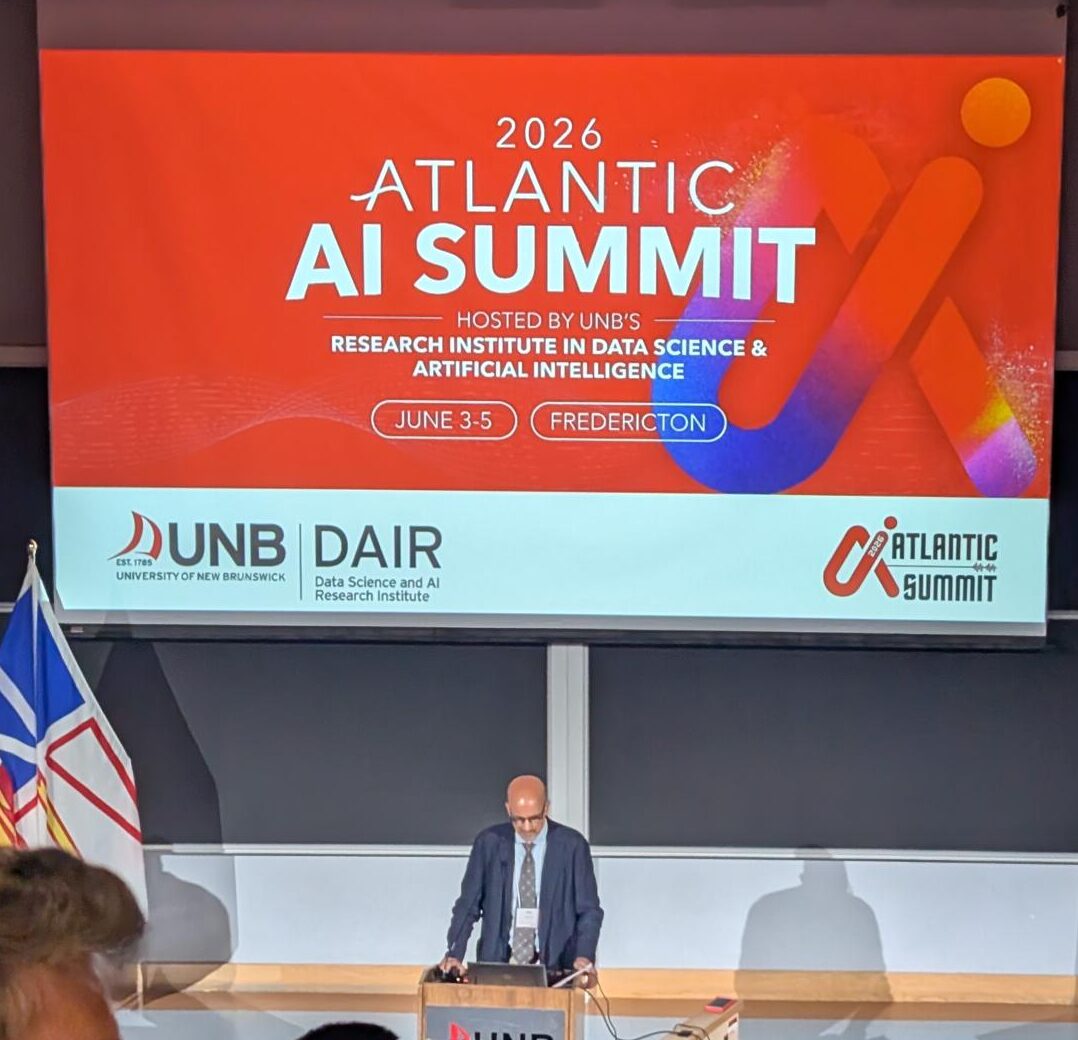
Last week I was fortunate enough to attend the 2026 AI Atlantic Summit at UNB right here in Fredericton New Brunswick. The conference was packed and really had a buzz to it. So much so that they had to open up overflow rooms where they streamed the presentations via video link so everyone could watch. The whole thing went off without a hitch and I really have to congratulate the Data Science and AI Research Institute (DAIR) formerly RIDSAI organizers Aaloak Jaswal and Scott Bateman for doing such a great job hosting.
The presentations at conferences can be a little dry but this conference seemed packed with interesting ideas on a wide range of subjects. There were a few snoozers mixed in, I won’t lie, but overall they were actually very interesting.
Just off the top of my head, I recall the talk ‘Sovereign Energy Data: the missing infrastructure for AI-ready electrification’ with Paul Vallee of Tehama.io who brought up the monopolistic power the big American tech companies have over our personal data. He also brought up the rights we should have surrounding our personal data. I believe Paul is apart of the Digital governance Council which looks to be doing some interesting work. (https://dgc-cgn.org/).
Then there was ‘AI-Driven Construction Intelligence: From Design Understanding to Manufacturing Optimization’ by Dr. Andrew Fisher of UNB. As a newly minted Professor Andrew leveraged existing systems to create a process where AI takes the blue prints from the Architect, removes all of the noise from the image and extrapolates the important markings, representing the buildings form. It them creates a 3D model of the building and determines the best pattern of cuts to construct the sections with the least amount of material. I believe this is a glimpse into the future. His papers can be found here:
BIRD (building perspective drawings to 3D model framework):
https://www.sciencedirect.com/science/article/pii/S0952197624018153,
JACK (building material estimation algorithm):
https://onlinelibrary.wiley.com/doi/abs/10.1111/exsy.70209,
PAAD (panelization optimization algorithm):
https://journals.plos.org/plosone/article?id=10.1371/journal.pone.0303646).
Another eye-opening presentation was in part by Tristen Tulkens of Smartskin Technologies. He was very upfront about the transformation of production software development being powered by generative AI to produce code. He said candidates applying for a job should at the very least have an opinion on the state of AI and its application to the software development life cycle. SmartSkin seems to be pushing the frontier when it comes to keeping up with he latest Silicon Valley trends.
I also wanted to rub elbows with likeminded developers and learn from their experiences within the industry. I was lucky enough to meet a few graduates from NBCC. One of which, Peter Groom, I was lucky enough to spend the lunch break with chatting about Claude code, MCP servers and where I should be diving into next to get a feel for things that are going on within industry. I took a great deal away from the conversation and really was intrigued with the Claude Code SDK he was using.
I left the conference feeling inspired knowing what is coming down the pipeline in terms of AI technology. It’s like I got to look into a crystal ball for a few days. There are certainly opportunities to be sought out right now.
What I walked away with is the knowledge that AI is going to be transformative. How it will unfold is yet to be seen. The systems have been strung upon us to quickly that it will take the next 10 years for us to catch up in our understanding and implementation of these tools.
What I do know is that everyone of us has a say in how AI unfolds. The best way to make informed decisions surrounding AI is by educating ourselves. This is how we empower ourselves in the age of technology.


